

An AI coding assistant can produce an impressive script in minutes and still be a poor fit for a game studio. The real test begins when the tool is expected to work inside repository rules, preserve secrets, follow project conventions, pass automated checks, and hand understandable changes back to a developer.
A small team can evaluate that fit without granting broad production access. Start with a disposable branch, synthetic data, one bounded task, and a written expected result. The pilot should make it easy to inspect what the assistant changed, what it ignored, and how the team can reverse the work.
Choose a Bounded Game-Development Task With a Known Answer
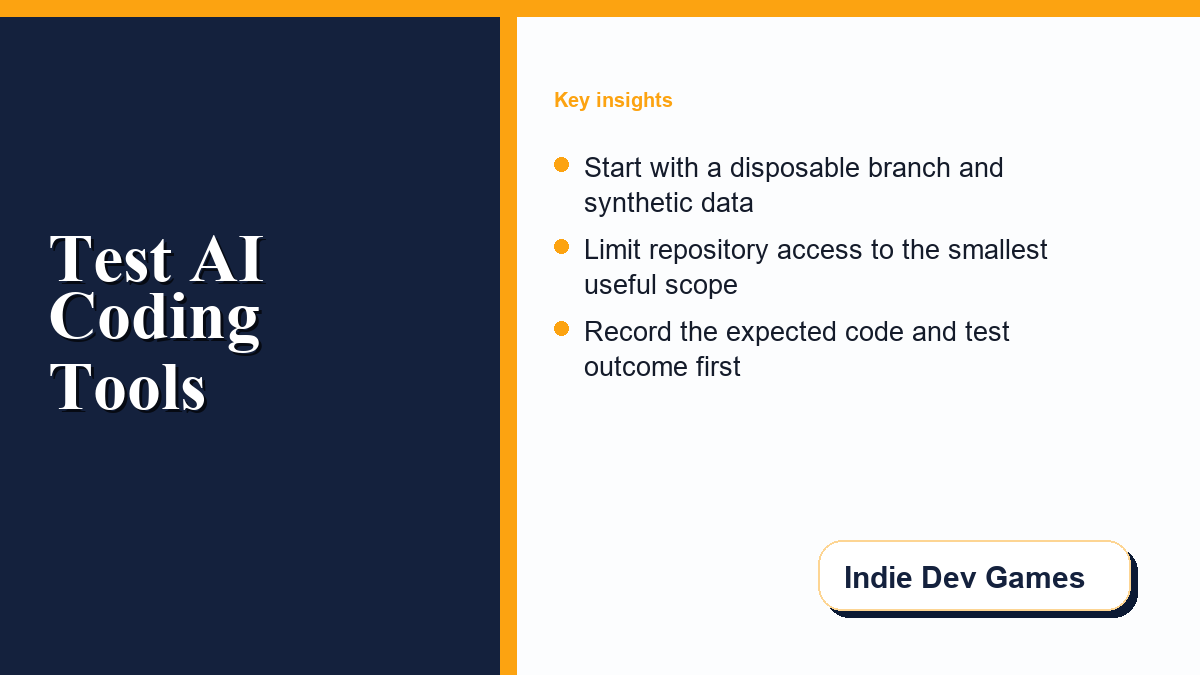
Pick a task that matters but does not control a production release. Good examples include adding validation to a save-file parser, writing tests for an inventory rule, documenting a build script, or refactoring a small editor utility. Avoid authentication, payments, live player data, signing keys, and release infrastructure during the first review.
Write the acceptance criteria before prompting the assistant. List the files it may touch, the expected behavior, required tests, prohibited dependencies, performance limits, and the reviewer who owns the final decision. This turns a vague experiment into a repeatable engineering check.
If the team is still deciding how to structure a testable prototype, Indie Dev Games’ game prototype testing guide provides a useful starting point for defining a small build and observable result.
Use a Disposable Branch and the Smallest Repository Scope
Create a clean branch from a reviewed commit and record the starting hash. Give the assistant access only to the files needed for the task. A focused utility rarely needs the entire game project, deployment configuration, private art library, analytics exports, or customer-support records.
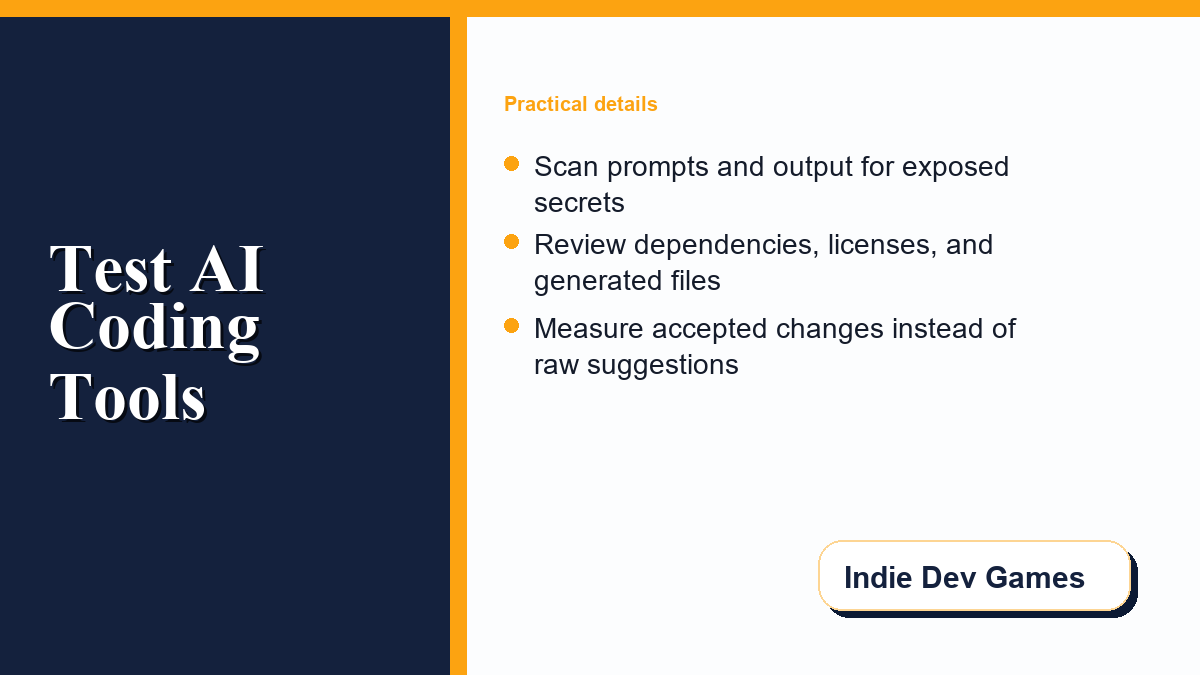
Replace real credentials and player information with fixtures. Check configuration files, build logs, screenshots, issue descriptions, and sample data before placing them in a prompt. Secrets can appear outside obvious environment files, especially in copied terminal output and archived setup notes.
The NIST Secure Software Development Framework organizes secure development around preparing the organization, protecting software, producing well-secured software, and responding to vulnerabilities. Those categories make a practical pilot checklist even for a two-person studio.
Compare Demonstrated Features With the Team’s Actual Workflow
Do not choose a tool because a prepared video shows a fast result. Check whether the current editor, repository host, test runner, programming language, and review process are supported in the exact configuration the team uses. Confirm which features belong to the free entry point, which require a paid plan, and which depend on separate model access.
Use this current review of coding-assistant features and limits as one dated comparison input, then verify the product’s current documentation before making a purchase or access decision. Pricing, quotas, supported models, and security controls can change after a review is published.
Ask the same questions for every candidate: Can it operate on a narrow file set? Does it show the proposed diff? Can the team approve changes before they are written? Are generated commands visible? Can a reviewer identify which model or workflow produced the result? Consistent questions prevent feature-heavy marketing from changing the evaluation standard.
Build a Repository-Access and Secret-Handling Checklist
Inventory the data the assistant could reach at each permission level. Read-only repository access, write access to one branch, pull-request creation, terminal execution, and organization administration are different risk classes. The pilot should begin at the lowest level that can demonstrate the required benefit.
| Access area | Pilot boundary | Evidence to capture | Stop condition |
|---|---|---|---|
| Source files | One disposable branch and named directories | Starting commit, file allowlist, final diff | Unexpected file access or modification |
| Commands | Reviewed local test commands only | Command list, exit codes, changed files | Unapproved network, install, or destructive command |
| Secrets | Synthetic values; no production credentials | Pre-prompt scan and post-output scan | Secret-shaped value in prompt, log, or result |
| Dependencies | Existing approved packages unless reviewed | Manifest diff, license, source, version | Unreviewed package or executable download |
| Publishing | No merge, deployment, store upload, or player delivery | Branch protections and reviewer settings | Any claim of release authority |
Enable the repository host’s secret-detection controls where available. GitHub’s secret scanning documentation explains how supported secrets can be detected in repository history and collaboration workflows. A scan is a safeguard, not permission to place credentials in prompts.
Review Generated Code as Untrusted Proposed Work
Treat every generated change like a contribution from an unfamiliar developer. Read the diff, trace input handling, check error paths, inspect dependencies, and run the project’s established tests. Generated code should not receive a lighter review because it looks polished or includes confident comments.
Look for hidden behavior around files, processes, network calls, telemetry, and logging. Check whether the code writes outside the expected directory, sends project material to a service, records private values, or downloads an executable. The CISA Secure by Design guidance reinforces the principle that customer security should be treated as a core product requirement rather than an optional setting.
Review open-source licenses and notices for generated snippets and new dependencies. If the assistant cannot explain the source of a large block, rewrite it or remove it. The studio remains responsible for what enters its repository and shipped build.
Test Behavior, Failure Recovery, and Regression Risk
Run the expected case, an invalid-input case, an empty-state case, and a failure case. For a save parser, that might include a valid file, a truncated file, a missing field, and an unsupported version. For an editor utility, test cancellation, missing assets, and an unwritable destination.
Record test commands and results rather than accepting a summary that says the task passed. If the assistant changed a test to make its implementation pass, review the test change separately. A passing suite is not useful when the expected behavior was quietly weakened.
Playtesting discipline transfers well to code review. This guide to using playtest questions effectively shows why a team should ask observable questions instead of collecting broad impressions. Apply the same method to generated code: identify the expected behavior, run the scenario, and record what actually happened.
Measure Accepted Engineering Work Instead of Suggestion Volume
Raw lines generated, chat messages, or accepted autocomplete events do not prove business value. Track the number of tasks that passed review without material repair, reviewer time, defects found before merge, new dependency risk, and the share of generated changes that the team discarded.
Include usage and subscription cost in the scorecard. Set a pilot ceiling before the test begins and record which plan or quota applied on the test date. Separate recurring subscription cost from model usage, repository hosting, CI time, and the developer time required to review and repair output.
For a broader shortlist, Messenger Bot’s coding-assistant comparison separates chat, editor and repository-task workflows and lists current access questions to review. Use it alongside your own pilot results rather than as a claim that one tool is safest or fastest. Disclosure: Indie Dev Games and Messenger Bot are under common ownership.
A useful result may be narrow. The assistant could be good at explaining unfamiliar code and writing first-pass tests while remaining unsuitable for autonomous changes. The pilot should produce a capability boundary, not a universal verdict.
Require Human Review Before Merge, Build, or Release
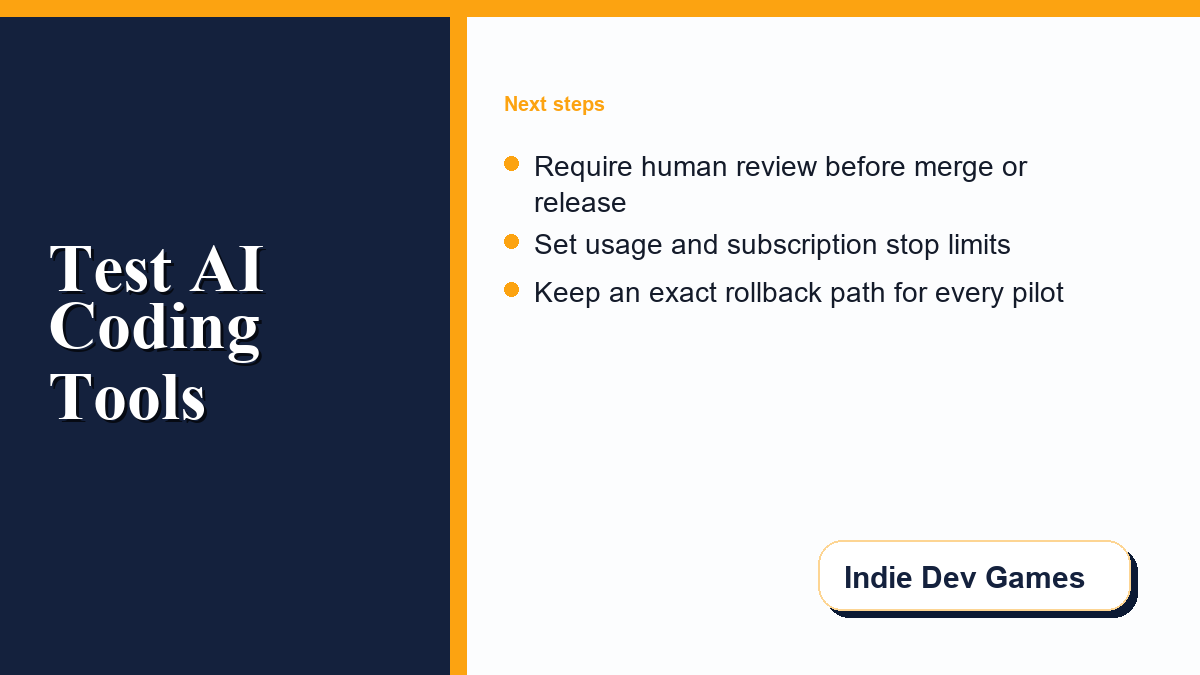
Assign a developer who understands the affected system to review the final diff. The reviewer should confirm the task scope, code behavior, tests, dependencies, security checks, documentation, and rollback. A tool-generated approval statement is not independent review.
Keep branch protection and release permissions outside the assistant’s control. The pilot should not merge its own work, alter required reviewers, change build secrets, publish a package, upload a store build, or message players. Those are separate actions with separate owners.
For higher-risk changes, require a second reviewer or security checkpoint. The OWASP Top 10 for Large Language Model Applications provides a useful vocabulary for risks such as prompt injection, sensitive information disclosure, excessive agency, and unbounded consumption.
Keep an Exact Rollback and Remove Pilot Access
Record the starting commit, branch name, tool permissions, installed extensions, configuration changes, and generated files. If the pilot fails, restore the branch to its reviewed state, remove the integration or token, revoke temporary access, and verify that no background job or webhook remains.
- Confirm the task and allowed files before granting access.
- Use synthetic data and a disposable branch.
- Record the starting commit and expected test outcome.
- Review every changed file and dependency.
- Run security, unit, integration, and failure-path checks.
- Require a named human reviewer before merge.
- Remove temporary access and verify rollback after the pilot.
Document the accepted capability, blocked uses, required reviewers, plan limits, and next review date. Product behavior and pricing change, so a decision should carry the evidence date that supports it.
Expand Only After the Pilot Produces Repeatable Evidence
A successful pilot should be repeatable by another team member. They should be able to start from the same commit, run the same task, apply the same access boundary, execute the same tests, and understand why the result passed or failed.
Expand one dimension at a time. The team might allow another repository directory, a larger refactor, or pull-request drafting, but not all three at once. Each expansion needs its own expected outcome and rollback path.
The best coding assistant for an indie studio is not the one that produces the most code in a demonstration. It is the one the team can constrain, inspect, test, afford, and remove without losing control of the project.
Frequently Asked Questions
Should an AI coding assistant get access to an entire game repository?
Begin with the smallest file set and permission level needed for one test. Broader access should require separate evidence, review, and approval after the narrow pilot passes.
What is a safe first task for an AI coding assistant?
Choose a bounded, reversible task with a known answer, such as adding tests to a small utility, validating fixture data, or documenting a build step on a disposable branch.
How can a studio prevent secrets from entering AI prompts?
Use synthetic values, scan files and copied logs before prompting, exclude production configuration, and review output for secret-shaped values. Revoke any credential that is exposed.
Which metrics show whether an AI coding assistant helps?
Track accepted tasks, reviewer time, repair effort, defects caught before merge, new dependency risk, and total tool cost. Suggestion volume alone does not show useful engineering progress.
When should a team stop an AI coding-assistant pilot?
Stop when the tool accesses unexpected files, exposes sensitive values, introduces unreviewed dependencies, changes tests to hide failures, attempts an unauthorized release action, or cannot be rolled back cleanly.

0 Comments