

Selling an independent game studio requires a deep understanding of both tangible assets and game catalog longevity. For developers planning a studio sale, an objective valuation from a broker like Midwest Business Brokers can provide financial clarity and reduce the chance buyers undervalue your intellectual property during initial deal discussions. The gaming industry is highly volatile, characterized by hit-driven revenues and shifting platform technologies. Therefore, a buyer will look far beyond your game’s current download chart. They will scrutinize the underlying cash flow, the predictability of your back-catalog, and the scalability of your development operations. To defend a strong multiple, you must present a clean financial narrative that clearly defines your studio’s profitability.
Defining SDE and EBITDA in the Gaming Industry
When valuing a game studio, buyers typically look at one of two financial metrics: Seller’s Discretionary Earnings (SDE) or Earnings Before Interest, Taxes, Depreciation, and Amortization (EBITDA). SDE is generally used for smaller, owner-operated studios. It calculates the total financial benefit generated for a single owner, including salary, personal expenses run through the business, and one-time equipment costs. EBITDA is reserved for larger, institutional studios where management is separated from ownership.
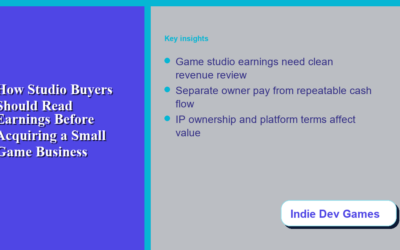
Understanding which metric applies to your studio is vital. It is helpful to research how studio buyers should read earnings before acquiring a small game business to ensure your financial reporting aligns with buyer expectations. Buyers want to see a clear line between capital spent on developing a new game and the ongoing costs of supporting live operations. If your development expenses are mixed with your live operations costs, your true earnings will be obscured, which will hurt your valuation.
Analyzing Historical Studio Revenue and Platform Concentration

A game studio’s revenue model has a massive impact on its valuation. Buyers look at the split between premium game sales, in-app purchases, subscriptions, and ad revenue. They also look closely at platform concentration. If ninety percent of your studio’s revenue comes from a single platform like Steam or the iOS App Store, a buyer will view the business as high risk. A change in platform terms or search algorithms could damage your studio overnight.
To mitigate this risk, you should document your back-catalog performance. A studio with multiple games that generate steady, passive sales is valued much higher than a studio that relies entirely on a single hit game. When preparing your financial narrative, show the historical decay curves of your game sales. Explain how updates, sales events, and DLC releases revive interest in your older titles. This evidence proves to buyers that your cash flow is sustainable and not a temporary spike.
Rationalizing Contractor Costs and Development Budgets
Independent game studios rely heavily on contract work for art, music, animation, and localization. While this keeps overhead flexible, it can complicate financial records during an acquisition. A buyer will want to see that all contractors have signed clear intellectual property (IP) assignment agreements. If you cannot prove that you own every line of code and every art asset, diligence can stall or force a price renegotiation.
From a financial perspective, you must separate development costs from operating expenses. Development costs are often capitalized, while operating expenses are expensed immediately. How you handle these costs impacts SDE and EBITDA. Furthermore, showing that you manage operating costs efficiently increases your value. For example, demonstrating workspace email and collaboration cost controls for indie game studios can show buyers that your studio maintains a disciplined approach to operational overhead, directly improving your bottom-line margin.
Intellectual Property Ownership and Code Audits

The primary asset of a game studio is its intellectual property. During due diligence, buyers will conduct a thorough technical audit of your game repositories. They will check the code quality, the use of open-source libraries, and the licensing terms of any middleware or engine you use, such as Unity or Unreal.
If your code contains open-source libraries with restrictive copyleft licenses, a buyer may demand that you rewrite that code before closing the deal. Additionally, you must show clear title to all trademarks, domain names, and game titles. Having an organized repository with complete documentation, clean licensing agreements, and clear IP chains of custody can reduce delays and make late-stage renegotiation harder to justify.
Support Tooling and Automated Support Margins
Ongoing player support and community management can become a significant cost center, especially for multiplayer or live-service games. Buyers will look at how much you spend on moderation, customer service, and community management. If your support costs scale linearly with your player count, your margins will shrink as your game grows.
To optimize your margins, you should demonstrate a scalable support system. Understanding how indie game studios compare AI chatbot apps before automating player support allows you to show buyers that you have implemented cost-effective automation to handle routine player inquiries. Utilizing modern tools can reduce the need for large customer support teams, keeping SDE and EBITDA stronger while showing that the studio has systems in place to support growth without a corresponding spike in overhead.
SDE Adjustments, Owner Compensation, and Add-Backs
To show the true earning power of your studio, you must identify and document all valid add-backs. In independent studios, owners often pay themselves a fluctuating salary, run personal travel to game conventions through the company, and purchase high-end hardware that is expensed immediately.
These discretionary expenses must be added back to your net income to show the true earnings. To do this accurately, consulting a professional Fort Wayne business valuation guide is highly recommended. A structured guide can help you identify permissible adjustments, such as one-time server transition costs or custom tool development, and keep adjusted SDE or EBITDA defensible during buyer negotiations.
Designing a Clean Financial Narrative for Diligence
The final step in preparing SDE and EBITDA is building a clean financial narrative. Do not just hand a buyer a stack of tax returns. Create a detailed spreadsheet that connects your monthly active users (MAU), average revenue per user (ARPU), and game development cycles to your financial outcomes.
Explain the seasonality in game sales, such as holiday promotions and platform sales. Show how your studio’s SDE has grown over time, and explain any anomalies, such as a temporary revenue drop during a game’s development phase. A clean financial narrative tells the story of your business, builds trust with buyers, and justifies the multiple you are seeking.
Conclusion and Preparation Steps
Preparing your independent game studio’s SDE and EBITDA for acquisition talks is a critical part of the exit process. By separating development from live operations costs, securing contractor IP assignments, automating player support, and documenting all discretionary expenses, you can present a more organized and lower-friction business to potential buyers. Start this preparation early, and you will be in a much stronger position to negotiate and defend the value of your studio’s creative catalog.


0 Comments